

The Gist
- Acquisition math is upside down. Ads cost more and convert less; without repeat behavior, CAC turns into a sunk cost.
- Retention funds growth. Profitability hinges on compounding value (AOV, frequency, churn reduction), not one-and-done clicks.
- Ops over optics. Real gains come from lifecycle ops—data structure, triggers, suppression, journey health—not campaign flair.
Editor’s note: This is Part 1 of our two-part series on the retention reset. Today’s installment tackles the why: the post-ZIRP correction, why acquisition-first economics are failing and why retention must become the center of gravity. Part 2 will cover the how: the infrastructure, staffing, process and metrics to operationalize retention at scale—complete with lifecycle definitions, suppression logic and journey health reporting.
For more than a decade, marketing budgets were shaped by the illusion of limitless growth. With interest rates pinned near zero, companies could spend freely on advertising, chase market share and report top-line growth while losing money on each customer acquired.
It did not matter if a customer stayed. It only mattered that they clicked. Under ZIRP, the next dollar of growth was always just another campaign away.
That era is over.
Table of Contents
The Cost Curve Broke The Funnel
Today, acquisition is not just expensive. It is inefficient. The cost to acquire a customer has increased by more than 220% in the last eight years. In 2024, Meta’s average price per ad rose 14% year-over-year to reach record levels. Google Ads costs increased substantially, with 86% of industries experiencing CPC rises averaging 10% and some sectors seeing up to 24% increases. TikTok advertising costs grew 12.28% year-over-year, with CPMs reaching $6.59 in Q1 2025 Companies are spending more to acquire less. And in many cases, they are losing money every time they bring someone new through the door.
Across industries, acquisition-first economics are collapsing. A 2024 study showed that brands now lose an average of $29 per new customer acquired; more than triple the $9 loss reported in 2013. Even with inflation, that gap is not sustainable. Yet most CX and marketing organizations continue to pour the majority of their budgets into acquisition channels, chasing volume instead of value.
Why ‘Clicks’ Masked Profitability
This is not because customer retention is unimportant. It is because acquisition is easier to sell.
It is more visible. It is more immediate. It is more idea-driven. Acquisition comes with creative briefs, pitch decks and launch parties. Retention, by contrast, is quiet. It is about operational consistency and efficiency, not campaign flair. It requires behavioral analysis, data structure, workflow management and long-term measurement (or at least, it should). It does not reward vanity customer metrics. It does not deliver dopamine.
However, the reality is that retention is what makes acquisition profitable. If customers do not come back, everything upstream collapses. The acquisition cost cannot be recovered. The growth forecast cannot be met. The LTV/CAC ratio falls apart. And the campaign that looked like a win on paper becomes a liability.
Related Article: Customer Retention: Strategies, Key Metrics & Examples
Customer Retention: Pivot or Correction?
The end of ZIRP has not created this problem. It has exposed it.
In an environment where funding is tight, boards are demanding profit and marketing budgets have already fallen 15% year-over-year, retention is no longer a preference. It is a requirement. Companies that fail to retain will not be able to afford to acquire. And no amount of creative will fix that.
This is not a pivot. It is a correction. Retention is not a new strategy. It is a long-overdue return to fundamentals. And in the post-ZIRP economy, those fundamentals will decide which brands endure and which disappear.
The Post-ZIRP Reality: Growth Without Retention Isn’t Growth
Retention has always mattered. It has always been the more rational play. But it was too easy to ignore for too long. The market conditions during the ZIRP era gave companies a free pass to behave irrationally. Cheap capital let them spend heavily on acquisition, even when the downstream economics were broken. Growth looked good on paper, so no one asked the harder questions.
The result? A generation of marketing leaders trained to chase reach instead of return. The loudest voices in the room were those who knew how to scale paid media. Performance was measured in quarterly spikes. A “successful” campaign meant clicks, not customers. Entire departments were built around acquisition metrics, CPM, CPC, ROAS, while retention became an afterthought, buried in lifecycle emails or occasional win-back tests.
This wasn’t a technology problem. The tools existed. The customer data existed. The infrastructure often existed, too, at least in part. The problem was strategic. Retention did not fit the growth narrative investors wanted to hear. It did not make headlines or win awards. It required slow, careful, operational work. That made it easy to deprioritize.
Related Article: How to Optimize Customer Acquisition and Retention
The ZIRP Incentive Structure (And Dirty Data Fallout)
The impact of such a culture is (partially) what has led to so many companies having such “dirty” data. A focus on acquisition — get as many new records into the database as possible — leads to data that is not reliable or accurate.
Mislabeling ‘Loyalty’ As Discounts and Chatbots
Even companies that claimed to care about retention usually treated it as a side project. What were labeled as customer loyalty programs, discount-based re-engagement or a customer support chatbot were labeled “retention.”
But these tactics were rarely connected to revenue, behavior or long-term strategy. They lived in silos and were measured in isolation. The real drivers of customer longevity, friction reduction, onboarding, value realization remained unmanaged.
And the cost of this neglect is staggering.
The 80/20 Blind Spot: Treating VIPs Like Everyone Else
Consider the data: 20% of a brand’s customers typically generate 80% of its revenue. But most companies do not even know who that 20% is. They do not track behavior, such as repeat engagement. They do not segment by lifecycle stage. They run batch campaigns to everyone and hope for the best. As a result, their most valuable customers receive the same treatment as their least engaged ones.
Now that capital is no longer free and acquisition costs are climbing, the margin for error is gone. Companies that built their growth model on front-end activity and ignored retention are being forced to confront the consequences. Their systems are bloated. Their data is incomplete. Their teams are stretched thin. And their budgets can no longer cover the gap between what it costs to acquire and what they recover from a customer over time.
Signals That Your Funnel Is Leaking
Quick checks to determine if acquisition spend is masking retention decay.
| Signal | What It Means | Immediate Action |
|---|---|---|
| Flat revenue, rising ad spend | Paid media is replacing churned customers | Cut frequency and invest in onboarding and reactivation |
| List growth, falling deliverability | Ghost contacts are inflating database volume | Apply decay thresholds and suppression logic |
| One-and-done purchases | Poor value realization after the first conversion | Map time-to-value triggers and usage nudges |
| Unknown VIP segment | No lifecycle or value-tier segmentation | Define active, lapsing, dormant; create VIP treatments |
Retention was never a luxury. It was always the foundation. But in the ZIRP-fueled race for scale, it was treated like a secondary metric. That era is over. The companies that survive this correction will be the ones that treat retention not as a fix, but as the core of their business model.
Why Retention Feels Harder…But Is Smarter
Ask most marketing teams why retention has taken a backseat, and you will hear a consistent theme: “It’s just harder.” And they are right. But that difficulty is not a reason to avoid it. It is a reason to prioritize it.
Fast Feedback Vs. Compounding Outcomes
Acquisition feels fun. It is fast-paced. It is creative. It generates metrics quickly. You launch a campaign, and within days you have data. Leads, clicks, impressions, conversions. You can point to a chart. You can justify the spend. Acquisition is thrilling because it delivers visible feedback and clear attribution.
Retention is not like that. It is long-term. It is invisible. It rarely has a launch date. It moves quietly through CRM automations, onboarding flows, triggered emails, support interactions, subscription logic and usage nudges. It does not show up in click reports. It shows up in outcomes, churn reduction, frequency lift, higher average order value and improved customer lifetime value.
But those outcomes take time. They come from compounding signals. They are harder to attribute, harder to explain and harder to celebrate. That is why many companies call themselves retention-focused but never follow through. They like the idea of retention. They do not like the grind.
Acquisition marketing has long dominated CX budgets for compelling psychological and structural reasons. 54% of B2C marketers allocate more than half their budget to acquisition, while only 13% dedicate the majority to retention. This imbalance persists despite overwhelming evidence that retention delivers 60-70% probability of success compared to acquisition’s 5-20%.
Related Article: The Loyalty Mirage: When Customer Lifetime Value Became a Moving Target
Cross-Functional By Design (Product × CX × Analytics)
Retention forces operational maturity. It demands coordination between marketing, product, customer service and analytics. It requires consistency. It requires infrastructure. It requires teams to go beyond the calendar-based campaign mindset and adopt behavior-based engagement logic. That shift is not easy, especially for teams that have been stretched thin and rewarded for short-term growth.
But it is smarter.
Retention builds equity. It strengthens revenue quality. It protects against market volatility. And most importantly, it pays for acquisition. At the same time, Qualtrics data shows that organizations globally risk $3.7 trillion annually due to bad customer experiences. If your customers do not return, your CAC becomes a sunk cost. Your revenue becomes unstable. And your growth becomes a treadmill, always moving, never gaining ground.
In contrast, a healthy retention strategy makes every new acquisition more valuable. Each first purchase is not just a win; it is the start of a longer revenue stream. It reduces pressure on paid media. It unlocks higher margins. And it creates resilience when acquisition channels become saturated or cost-prohibitive.
Still, many organizations struggle to operationalize it.
Part of the challenge is resource allocation. Retention teams are often smaller, underfunded or buried within CRM or support roles. They are told to “optimize lifecycle,” but given no insight into product data, usage patterns or service performance. They are asked to “improve loyalty,” but loyalty is not a campaign, nor is it typically a recommended effort. It is a reflection of how well the company continuously delivers on its promise.
Measurement Gaps: CLV, Decay and Cohorts
Another challenge is measurement. Many teams do not know how to measure retention beyond churn. Only 42% of companies can accurately measure customer lifetime value (CLV). They cannot track behavioral drop-off. They do not segment users by lifecycle stage. They rely on outdated metrics like email open rate, which no longer reflect engagement due to privacy changes like Apple Mail Privacy Protection. They lack the analytics to see who is fading, why they are fading and how to intervene.
Ownership Gaps: Everyone Cares, No One Owns
And perhaps most importantly, retention lacks ownership. It lives between departments, which means it is easy to deprioritize. Everyone cares about it, but no one is responsible for it. Without a mandate, it drifts. Without KPIs, it gets overlooked. Without visibility, it never earns the same respect as acquisition.
But the smartest companies are changing that.
They are giving retention a seat at the table. They are building lifecycle infrastructure. They are creating shared dashboards that track engagement health. They are suppressing ghost contacts from campaigns. They are tying retention strategy to revenue forecasts. They are not just “doing email,” they are designing systems that support long-term behavior.
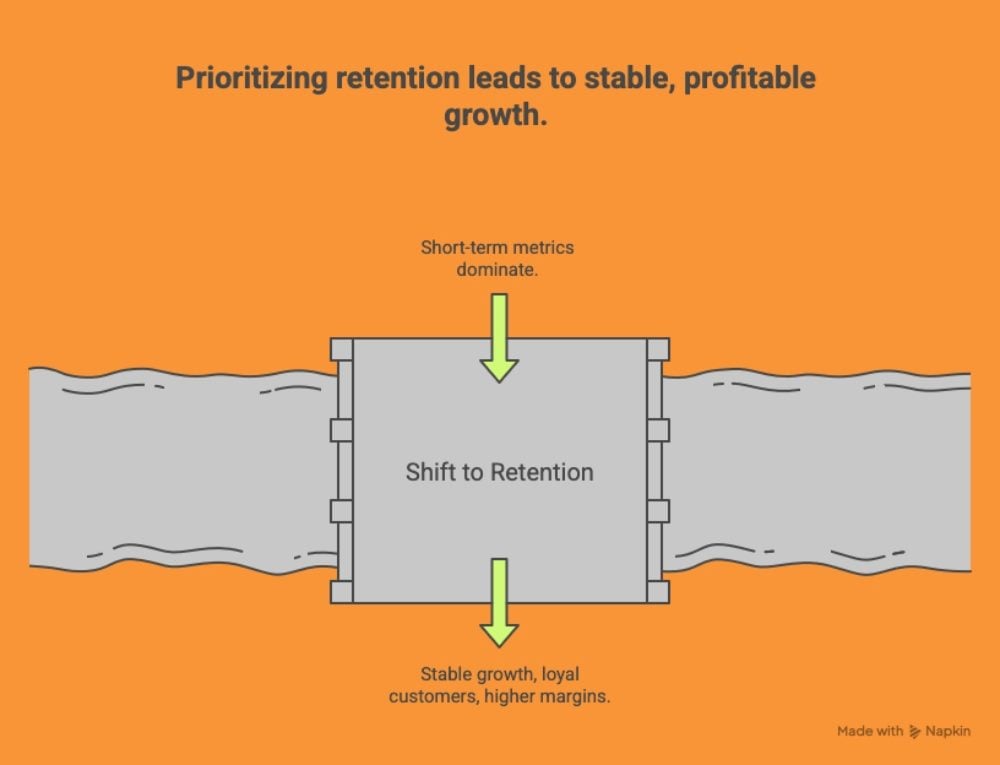
Retention may feel harder. But in a post-ZIRP world, it is the only way to create stable, profitable growth. And once the system is built, retention becomes a force multiplier. It turns one-time customers into advocates. It turns paid media into margin. And it turns operational excellence into competitive advantage.
Core Questions About Retention-Led Growth
Editor’s note: Key questions on retention’s role in profitable growth, measurement, and operations.
 Learn how you can join our contributor community.
link