Subaru wanted to understand how its marketing team should respond to new electric vehicle legislation in the United States. They also wanted to determine how experiential marketing events, where people can test drive and learn about the vehicles, impact EV sales and whether those events could help Subaru meet the new legislation targets.
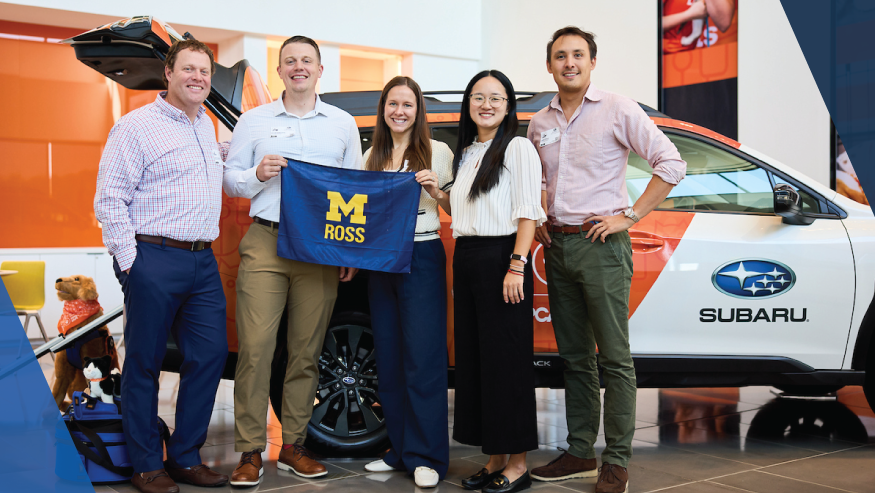
James Baker, OMBA ’25; Tianyi Sheng, OMBA ’25; Jacob Marcotte, OMBA ’25; Ashley O’Brien, OMBA ’26; and Brent Dingman, OMBA ’25, worked with Subaru and delivered actionable recommendations to improve experiential marketing events. Subaru has already begun implementing the team’s suggestions.
Confidence in collaborating with Michigan Ross students
MAP allows students to apply the skills and frameworks they’ve learned in the classroom to real-world business challenges. After 14 weeks of consulting with the sponsor and receiving guidance from faculty, the students deliver a final analysis of the problem and their recommendations.
The Subaru MAP sponsor, Joe Pawlicki, owner loyalty and engagement manager at Subaru of America, heard about the Michigan Ross MAP program through a former colleague who was a Ross alum. Pawlicki decided to sponsor the project because the alum spoke highly of her MAP experience and the support she received from Ross faculty. Pawlicki especially liked the idea of receiving guidance from faculty instead of an external business consultant.
Incorporating feedback and refining goals
At the start of the project, the Subaru MAP team gathered marketing data and information to understand the impact of electric vehicle legislation and the effect that experiential marketing events had on Subaru EV sales. Pawlicki connected the students with Subaru’s advertising, project management, marketing, and sales teams so that they could gather information and interview Subaru team members and vehicle owners.
After analyzing their data, the team developed initial recommendations to present to Subaru at the project’s midpoint review. The sponsor offered constructive feedback, highlighting areas that didn’t fully align with the brand strategy and guiding the team on where to refine their approach.
In response to their data analysis and the sponsor’s feedback, the team proposed pivoting the project to focus less on ROI and more on enhancing experiential marketing for new EV models. The Subaru team’s feedback helped students like O’Brien understand why it was necessary to change their approach.
“We found that the car purchase cycle is so long and complex that it’s difficult to demonstrate the return on investment of specific marketing efforts,” said O’Brien. “We did our best to be thorough with what we could show and use data that was directionally helpful. Through this process, we learned how to communicate through challenges and provide other creative solutions.”
Blending virtual learning with real-world experience
While the OMBA Program includes a mix of online and in-person coursework, for MAP, the students traveled on-site to the Subaru of America Headquarters in New Jersey for a few days to get to know their sponsor, attend some experiential marketing events, and conduct research in person. The students agreed that the real-world components of the MAP project complemented their coursework and helped enhance their learning.
“When I got to use the tools I was learning in class on a real-life problem at a real company, it felt very rewarding, like the whole program was worth it, and here was the proof,” said Baker. “It gave me confidence that what I learned from MAP and the rest of the program will be things I will use for the rest of my career.”
“This experience highlighted how the theories we learned in class, like the customer journey, can be effectively applied in a real-world context,” said Sheng. “It was fulfilling to contribute to meaningful solutions that could help Subaru improve and increase sales.”
Coming from diverse professional backgrounds, including health care, engineering, and entrepreneurship, the students also appreciated the opportunity to learn about the automotive industry firsthand.
Our Subaru MAP project pushed me outside my comfort zone in the corporate real-world environment. The multidisciplinary education I’ve accumulated at Ross provided the foundation to solve complex business problems and forced me to be comfortable making decisions without all the information.
Brent Dingman, OMBA ’25
A foundation for future partnerships
Pawlicki says that the OMBA students provided great marketing insights and suggestions to improve the customer test-drive experience and increase EV sales, which Subaru is already implementing at experiential marketing events. He also said he would consider sponsoring another project and recommend working with Ross students to other companies.
“Working with the MAP program was an absolute delight,” said Pawlicki. “The students brought a fresh perspective to our business with new ideas and incredible passion. Their diverse backgrounds led to a final deliverable that was thoughtful, forward-thinking, and built for the future ahead. We have a whole new outlook on how we will be designing and hosting experiences for our customers. From the program administrators and the faculty advisors to the team of students, the attention to detail and focus on excellence were incredible.”
link